

CPAC’s Iran Focus Draws on Muslim Suffering to Justify War, pushing for US aggression
As the conference closed, speakers invoked the pain of Iranian civilians—many of them Muslim—while pressing for U.S. military action

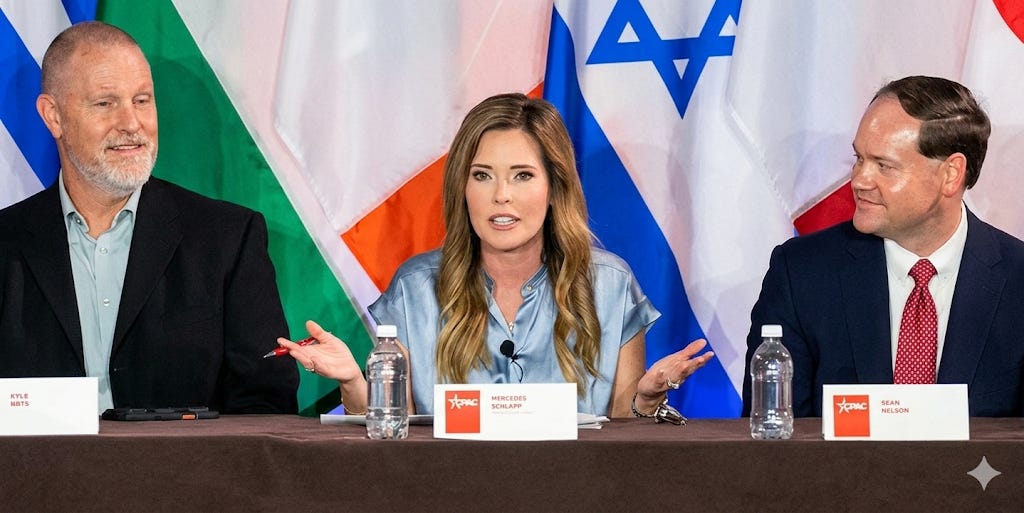
The closing mood at the Conservative Political Action Conference (CPAC) this year was shaped overwhelmingly by foreign‑policy anxiety, internal conservative division, and a strong push by key speakers to rally the base around the U.S. war in Iran. The final-day tone and messaging were unmistakably centered on Iran, national security, and ideological unity.
As the conference closed, speakers invoked the pain of Iranian civilians—many of them Muslim—while pressing for U.S. military action, raising questions about whose voices are centered and whose futures are decided.
CPAC’s closing sessions leaned on stories of Iranian repression to rally support for U.S. strikes, blending solidarity with Muslim victims and support for expanded military power.
Emphasis on Iran: The Dominant Theme
Across the final sessions, Iran was the gravitational center of the event:
Speakers aligned with Trump framed the Iran conflict as a moral and strategic necessity, urging conservatives to “stand strong” with the administration’s military actions.
CPAC senior fellow Mercedes Schlapp used testimonies from Iranians injured in the 2022 protests to argue that U.S. strikes were part of a liberation struggle.
Despite this push, the event closed under a cloud of growing voter unease, with high fuel prices and skepticism about the war’s rationale threatening Republican midterm prospects.
The conservative movement’s internal split over the Iran war was visible even in late‑conference programming, with figures like Steve Bannon warning that a prolonged conflict could “bleed support.”
The closing tone was therefore a mix of defiance, moral framing, and strategic worry.
Muslims & Muslim‑majority Contexts: How They Appeared in the Narrative
While Muslims as a community were not a central explicit focus of the closing sessions, they were present in two important ways:
Iran framed through a religious‑political lens
Speakers repeatedly cast the conflict as a struggle against the “mullahs” or theocratic leadership of Iran.
The session titled “MAGA vs. Mullah Madness” used religious language to contrast the U.S. with Iran’s clerical leadership.
This framing implicitly tied the closing‑day rhetoric to broader narratives about political Islam, though not about Muslims as a global community.
Muslims as victims of authoritarian regimes
By highlighting Iranians shot by security forces, CPAC speakers positioned Iranian civilians—many of them Muslim—as victims of state repression, using their stories to justify U.S. military action.
This approach allowed speakers to claim solidarity with oppressed Muslim populations while still advocating for aggressive U.S. intervention.
Overall Closing Message
The closing atmosphere at CPAC can be summed up as:
· Unifying the base around Trump’s Iran policy, despite national skepticism
Moralizing the conflict, using Iranian victims’ stories
Downplaying internal conservative fractures, even as divisions were evident
Positioning the U.S. as a defender of freedom, including for Muslim populations under authoritarian rule
The result was a closing ceremony that blended militaristic resolve, ideological storytelling, and strategic defensiveness.