

Is Keith Self Offering Consistent Leadership—or Sending Conflicting Messages to Voters?
Sharia dollars, secret promises, voters must decide for them Self!

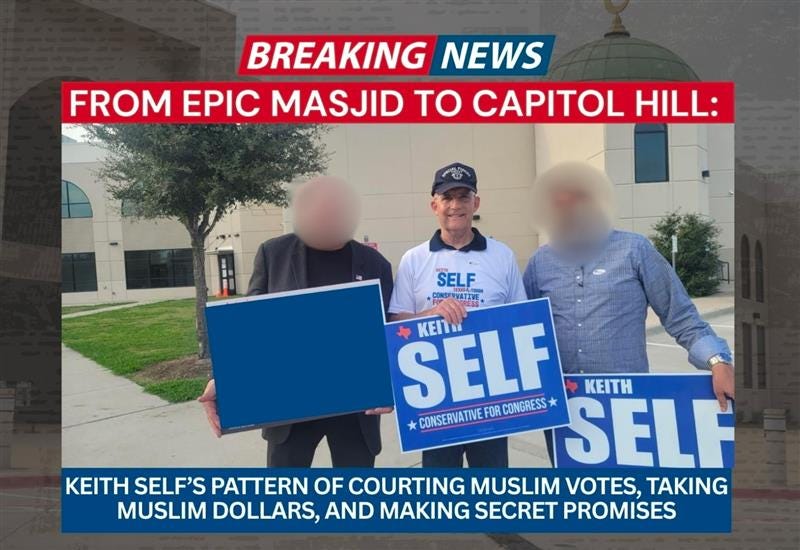
Congressman Keith Self is under growing scrutiny for a glaring contradiction at the heart of his political career: publicly attacking Islam while privately relying on Muslim communities to climb to power.
In Washington, Self has cast himself as a leading opponent of Sharia law through his role in the so-called “Sharia-Free America Caucus,” portraying Islam as a threat to American values. Critics say the reality is simpler and more troubling: a textbook case of political double-dealing.
During his 2022 campaign, Self aggressively courted Texas Muslims. Multiple accounts confirm he campaigned at the East Plano Islamic Center (EPIC), attended Muslim community events, visited Muslim homes, raised campaign funds from Muslim donors, and made assurances behind closed doors. These were not one-off meetings, but a sustained strategy to secure votes, money, and legitimacy.
After winning his first election, Muslim leaders organized a celebratory event at the DoubleTree Hotel in Richardson. Self attended with the Republican leadership and thanked the community for its support. What was presented as criticism now views outreach as the prelude to betrayal.
That history came into sharp focus on November 24, 2025, when Self took to the House floor and launched a direct attack on Islam and Muslims. He claimed that “Islam is a culture with a patina of religion,” said it is “stuck in the 8th century,” and labeled Sharia a “culture of violence and domination.”
The speech capped a national media blitz in which Self elevated Islam and Sharia as supposed national threats—even though there is not a single documented case of Sharia law being adopted by any legislative body in the United States.
Further undermining his credibility are reports that around 10 days before that speech, Self attended a private fundraiser with Syrian Muslim doctors in Dallas. Attendees recall a warm, familiar setting in which Self greeted guests personally and spoke fondly of his wife’s travels in Muslim-majority countries such as Egypt. Witnesses say such private fundraisers in Muslim homes were common throughout his rise.
The contrast is stark.
Critics argue that Self accepted Muslim votes, donations, and hospitality, made private assurances, and then weaponized Islamophobia for political gain. They say this was not a shift in belief, but an exploitation of a minority community for political gain.
Self has also faced criticism for selective silence. While waging a high-profile campaign attacking Islam through press conferences, interviews, and podcasts, he has avoided addressing the Epstein files or speaking publicly about accountability for the victims involved. Opponents say the Sharia crusade functions as a convenient distraction.
Community leaders insist the issue is not ideology, but integrity.
“This isn’t a misunderstanding,” said one organizer familiar with Self’s outreach. “It’s a pattern—private reassurance, public condemnation.”
As scrutiny intensifies, critics are calling on Keith Self to disclose the promises made during his private outreach and to state whether he will return campaign funds taken from Muslim donors he now publicly condemns.
Voters now face a simple question: Does Keith Self represent principled leadership or another Washington politician with two faces, two messages, and no credibility?