

Islam and Sharia shaping the 2026 TX-03 Republican primary, says independent media
Fear-based claims about ‘Sharia law’ are driving conversations in Collin County, but district deserves conversations grounded in facts, not fabricated threats - editorial

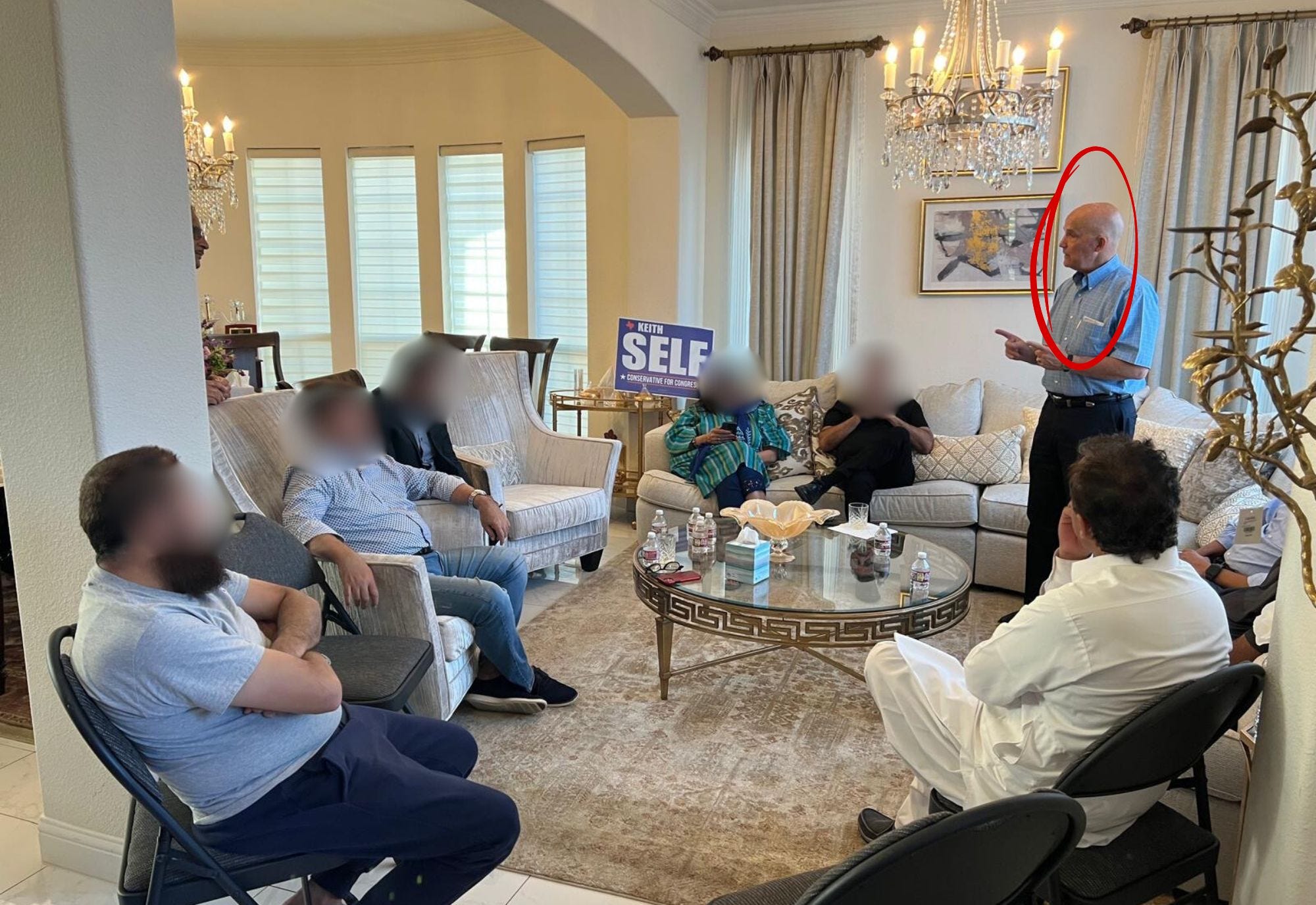
At Rep. Keith Self’s recent Allen town hall, the first audience question urged him to “stop Sharia law” and asked whether hijabs should be banned. Instead of correcting the misconception, Self embraced it—casting Sharia as an ideological threat and later repeating claims about American cities being “conquered,” without evidence or context, wrote TX3DNews in an Editorial on 20 February.
Days later, the independent local news outlet wrote that Self had doubled down online, declaring on November 23: “I’m proud to stand on the front line in the fight against Sharia in America… This isn’t just politics. This is a fight for the soul of Western civilization.”
The issue now is not just whether these claims are accurate. It is whether this message resonates in a suburban, highly educated, rapidly diversifying district—or whether it reflects a deeper political strategy built on fear rather than policy.
What Sharia Actually Is — And What Politicians Pretend It To Be
Context Corner MD, Dr. Taha Ansari, quoted in the editorial as a local Muslim leader, captures the issue clearly: “Politicians in America have weaponized the phrase ‘Sharia law’ as a political scare tactic… making Muslim Americans appear foreign or incompatible with American values despite being an integral part of the nation’s fabric.”
He notes what political rhetoric routinely ignores: Sharia is not a civil legal code. “The word sharia simply means ‘the path’ in Arabic,” he explains—a moral and spiritual framework guiding prayer, charity, and ethical conduct, much like biblical principles for Christians or halakha for Jews. It is personal guidance, not something imposed on others. And, as Ansari emphasizes, “Muslims are obligated to follow the law of the land under Sharia.”
The publication argues that there is no theological mandate or political movement seeking to impose a religious court system in North Texas. The idea persists because it is politically useful, not because it is real.
But the consequences are real. Claims that “Sharia law” is overtaking America fuel harassment, suspicion of hijabs and mosques, and the marginalization of Muslim families—many long-rooted in Collin County. In communities with significant Muslim populations in Allen, Plano, Frisco, and McKinney, what begins as a talking point becomes a lived reality.
When Legislation Becomes Performance
Democratic challenger and military veteran Evan Hunt argues that Self’s approach to HR 5722 reveals a larger strategy: using Sharia as a political scare narrative. “In America, we do not fear or demonize other cultures—we welcome them,” he wrote, contrasting national values with Self’s rhetoric. Hunt says the bill “tries to solve a problem that does not exist,” warning that it fuels Islamophobia while diverting attention from issues that actually affect North Texas families.
Proponents, including Self and Rep. Chip Roy, claim the measure targets foreign extremists misusing asylum rules, not Muslim Americans. But legal scholars note the rationale mirrors earlier anti-Sharia efforts struck down in court and rests on the same unfounded premise that Islam itself poses a special threat.
In practice, the bill’s vague references to “Sharia influence” reinforce the notion that Islamic belief is inherently suspect—amplifying fear rather than addressing any real policy challenge in TX-03.
Self’s rhetoric may animate a slice of the GOP base, but is it growing his coalition? Is it addressing any real local problem? Is it aligned with what residents actually want their representatives to focus on? Or is it simply the safest message in an environment that rewards escalation over governance?
TX-03 Deserves More Than Fear-Based Politics
Collin County is not the caricature such rhetoric assumes. It is a sophisticated suburban district with global businesses, world-class schools, and a rapidly expanding immigrant community that strengthens the region.
The district deserves conversations grounded in facts, not fabricated threats.
It deserves representation willing to engage real issues—not imagined cultural battles.
And above all, it deserves leaders who understand that diversity is not a civilizational threat; it is the defining characteristic of modern North Texas, the editorial concluded.