

'Muslims Are on the Menu’: Texas Panel Calls for Ban on Islam as hate-speak continues
As Muslims observe the holiest month of the year, a church‑hosted political forum in North Texas aired calls to criminalize Islamic practice

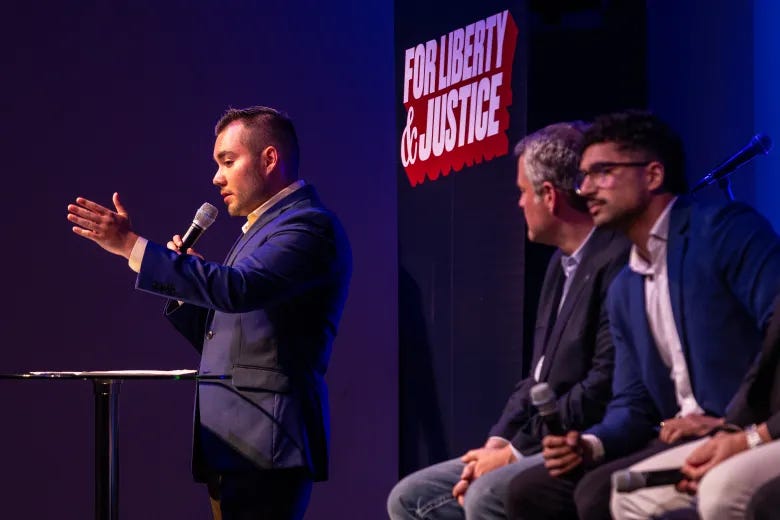
Political and religious leaders at a North Texas church discussed deporting, jailing or converting Muslims as a way to eradicate what they described as the “threat of Islam” in Tarrant County and across Texas, according to reporting by the Fort Worth Report.
The panel took place Thursday night — just days after the primary elections and during Ramadan, Islam’s holiest month.
During the discussion at Light of the World Church in Fort Worth, a Republican state lawmaker suggested Texas could strip Islam of constitutional protection by redefining it as a political ideology rather than a religion.
“We could basically say, ‘In the state of Texas, we get to define what a religion is, and Islam is not a religion protected under the First Amendment,’” said state Rep. Andy Hopper, who represents Wise County.
The event was hosted by For Liberty & Justice, the political arm of Mercy Culture Church, and featured five panelists, including a former FBI agent, a failed congressional candidate and a self‑described former Muslim turned Christian influencer.
Political scientists say the rhetoric marks a sharp escalation from familiar anti‑Muslim campaign messaging. Matthew Wilson, a professor at Southern Methodist University who studies religion and politics, said the open discussion of banning or criminalizing Islam crossed a new line.
“Even the suggestion that you could outright ban the practice of the world’s second‑largest religion is noteworthy,” Wilson said. “That’s a real escalation.”
More than 31,000 Muslims live in Tarrant County, according to 2020 data, making up about 1% of the Dallas–Fort Worth population. Yet fears of “Islamization” have gained traction in local Republican circles, particularly during recent primaries, with candidates promising crackdowns on sharia law and Muslim civic organizations.
Carlos Turcios, the local director of For Liberty & Justice, organized the panel in response to a proposed Muslim‑centric residential development northeast of Fort Worth that has faced months of legal challenges and political backlash. Turcios described the panel as a “healthy debate,” expressing concern about Muslims forming “segregated communities.”
Local Muslim leaders strongly rejected that characterization. Khalid Hamideh, spokesperson for the Islamic Association of North Texas, said he was stunned to hear an elected official discuss effectively banning Islam.
“This is very extreme,” Hamideh said. “They’ve really pushed it to the outer limits.”
Hamideh drew a stark contrast between the panel and his own Thursday evening, spent breaking fast with Jewish and Christian leaders at an interfaith iftar in Richardson. “Muslims are on the menu, and we’re on the ballot,” he told attendees.
Several panelists advocated banning sharia, though they acknowledged constitutional barriers. Wilson noted that U.S. and Texas law already prevent religious codes — Islamic or otherwise — from being enforced by the state, while protecting individuals’ right to follow their moral beliefs.
Hamideh compared sharia to the Ten Commandments, calling it a personal moral framework rather than a parallel legal system. He warned that inflammatory political language has real‑world consequences, including bomb threats to mosques, harassment of Muslim children and death threats to families.
“The consequences are real,” he said. “Their words carry weight.”
Despite calls from one panelist to use more “respectful” language and focus on religious conversion rather than punishment, the evening underscored a growing willingness among some political and religious leaders to openly challenge Muslims’ place in public life — even as Muslim communities continue efforts toward dialogue, education and coexistence.