

Paxton Sues East Plano Islamic Center, Alleging Illegal Securities Scheme Behind ‘EPIC City’ Development

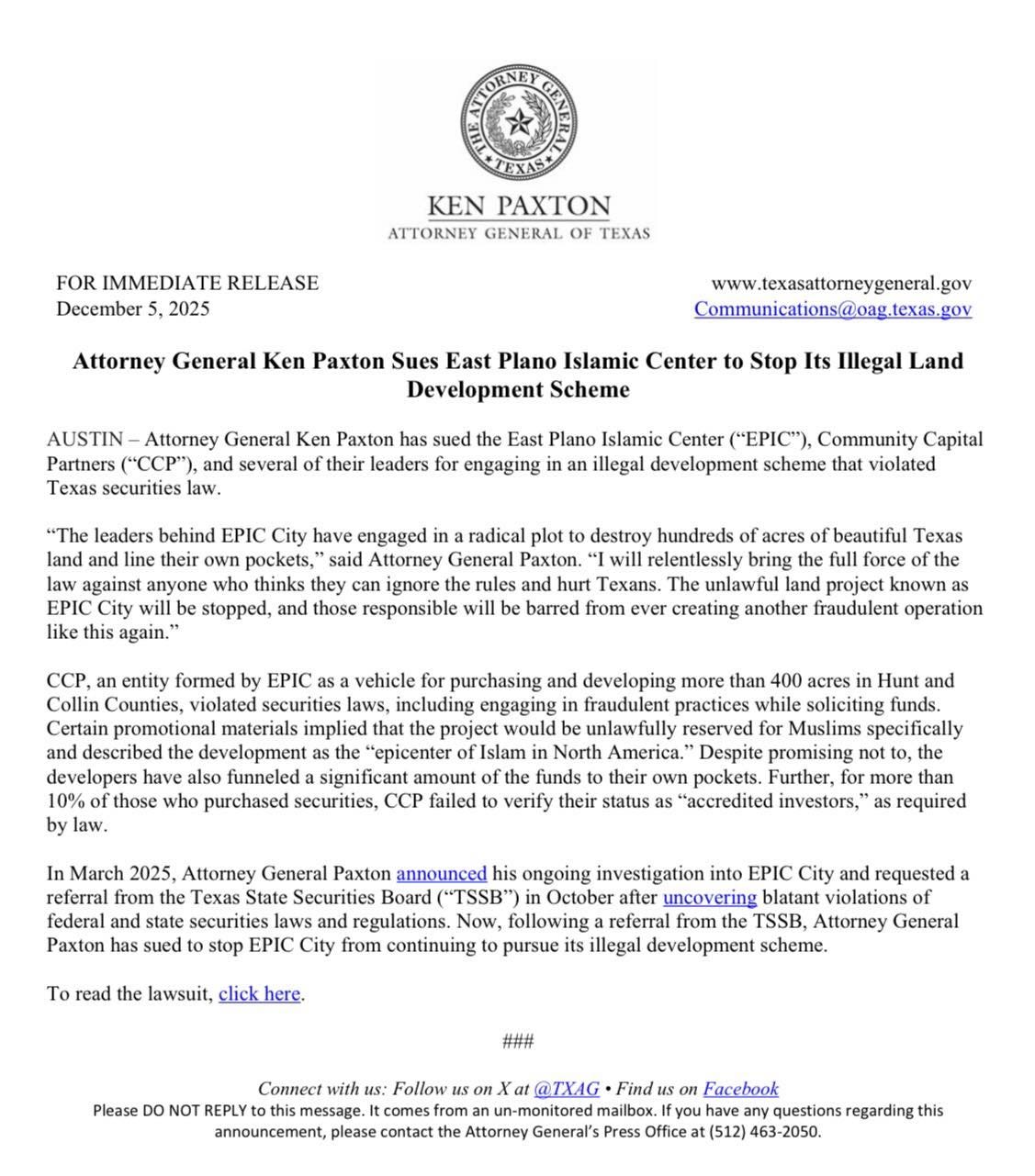
Texas Attorney General Ken Paxton has filed a lawsuit in Collin County against the East Plano Islamic Center (EPIC), its investment vehicle Community Capital Partners, and several leaders, accusing them of running an illegal securities and land development scheme tied to a 400‑plus‑acre housing project once branded “EPIC City” and now known as “The Meadow.” The suit, filed December 4, follows a months‑long investigation and a referral from the Texas State Securities Board and seeks to halt fundraising, freeze assets, and unwind investments in the master‑planned Muslim‑centered community proposed in unincorporated Collin and Hunt counties, northeast of Dallas. Paxton announced the move in a social media statement calling the project an “unlawful land project” and the financing model a “radical plot to destroy hundreds of acres of beautiful Texas land and line their own pockets.”
Lawsuit Alleges Fraud, Unregistered Securities, and Misleading Marketing
According to the verified petition summarized by KERA News and Fox News, the Attorney General alleges that Community Capital Partners sold investment interests—typically priced between 40,000 and 80,000 dollars—to hundreds of buyers without registering the securities or qualifying for exemptions under state and federal law. The filing claims the developers broadly solicited investors at meetings, via social media, and through online promotional videos, conduct that regulators say is prohibited under the exemptions CCP asserted.
The suit further alleges that EPIC and CCP failed to take “reasonable steps” to verify that purchasers were accredited investors and misrepresented both the project’s location and the compensation of project leaders. Marketing materials reportedly continued to describe the community as being “in the heart of Josephine, Texas” even after city officials confirmed in February 2025 that the land lay outside Josephine’s limits and utility district. A Texas Securities Board review concluded that EPIC entities had sold securities without meeting registration or exemption requirements and referred the case to Paxton after determining there were “flagrant” violations, according to Texas Border Business and Yahoo News.
“The leaders behind EPIC City have engaged in a radical plot to destroy hundreds of acres of beautiful Texas land and line their own pockets,” Paxton said in a written statement announcing the suit. “I will relentlessly bring the full force of the law against anyone who thinks they can ignore the rules and hurt Texans.”
A 402‑Acre Muslim‑Focused Development Under Political Scrutiny
The project at the center of the lawsuit began in late 2024 as EPIC City, a 402‑acre master‑planned community marketed by EPIC and CCP to serve the rapidly growing North Texas Muslim population. Plans presented to county officials and in promotional material included more than 1,000 single‑family and multifamily homes, a new mosque, a K‑12 faith‑based school, senior housing, an outreach center, commercial areas, sports facilities, and a community college, located near the small city of Josephine, about 40 miles northeast of Dallas.
Resident scholar Yasir Qadhi of East Plano Islamic Center announced the first residential sales in November 2024, saying the development was intended as a community‑funded project using share purchases rather than traditional home sales, and that local outlets, including The Dallas Morning News, had reported on the story. Supporters argued that the model allowed middle‑income Muslim families to buy into a faith‑oriented neighborhood while integrating schools, worship spaces, and services into a single site.
The development quickly drew state‑level attention. In March 2025, Governor Greg Abbott directed multiple agencies—the Texas Rangers, Texas Workforce Commission, Texas State Securities Board, and Texas Funeral Service Commission—to investigate EPIC City for potential violations of securities and consumer‑protection rules, as well as fair‑housing and funeral‑licensing requirements. At public hearings before the Collin County Commissioners Court, some residents raised concerns about infrastructure. In contrast, others voiced fears about “Sharia law” and described the neighborhood as a potential “compound,” according to KERA News and other local reporting.
Investigations, Rebranding, and Mixed Regulatory Outcomes
Over the past year, multiple probes reached different conclusions. The U.S. Department of Justice closed its civil‑rights investigation into EPIC City in June 2025 without filing federal charges, following an inquiry initiated after Senator John Cornyn raised concerns that non‑Muslims might face discrimination. In September, Texas Workforce Commission fair‑housing complaints were resolved through settlement, with no publicly announced enforceable violations, KERA News and CBS Texas reported.
However, state‑level scrutiny continued. The Texas Funeral Service Commission ordered EPIC to halt certain burial practices, alleging it operated an unlicensed funeral home. However, some claims were later downgraded, and the mosque resumed limited services while litigation over religious burial rights proceeded. On October 13, Paxton publicly stated that his office had found evidence of securities law violations by entities connected to EPIC City and formally requested that the Texas State Securities Board review the findings and consider referring the case back for prosecution.
Amid the controversy, Collin County Judge Chris Hill announced in November that the development had been rebranded as “The Meadow,” sharing a revised site diagram on social media. Community Capital Partners confirmed the name change to The Dallas Morning News, while noting that formal land‑use plans were still pending before county and environmental regulators.
Muslim Advocates See Broader Pattern, EPIC Yet to Respond
Civil rights organizations, including the Council on American‑Islamic Relations, have argued in related statements that enforcement actions tied to EPIC City occur in a broader climate of suspicion toward Muslim institutions in Texas, pointing to recent efforts by Abbott and Paxton to designate CAIR and the Muslim Brotherhood as terrorist organizations and to restrict land ownership by certain foreign‑linked entities. CAIR’s 2025 civil‑rights reporting and independent analyses by USA Today and Al Jazeera have documented sharp rises in anti‑Muslim incidents nationwide since 2023, including disputes over mosque construction and zoning.
As of KERA’s latest report, EPIC and Community Capital Partners had not publicly responded in detail to Paxton’s new lawsuit, though past statements by former EPIC board president and CCP executive Imran Chaudhary stressed that the project “follow[s] every single law…from the state perspective to the federal perspective” and is open to all residents regardless of faith. The Collin County court will now decide whether to grant Paxton’s request for an immediate restraining order and longer‑term injunctions, as well as potential civil penalties and restitution for investors, outcomes that could determine the future not only of The Meadow but of similar faith‑linked community developments across Texas.