

Texas Reacts to Trump’s Escalating Iran Rhetoric: A State at the Crossroads
Trump’s warnings towards Iran makes the national debate more intense, with Texas leaders sharply divided along party lines — highlighting global tensions

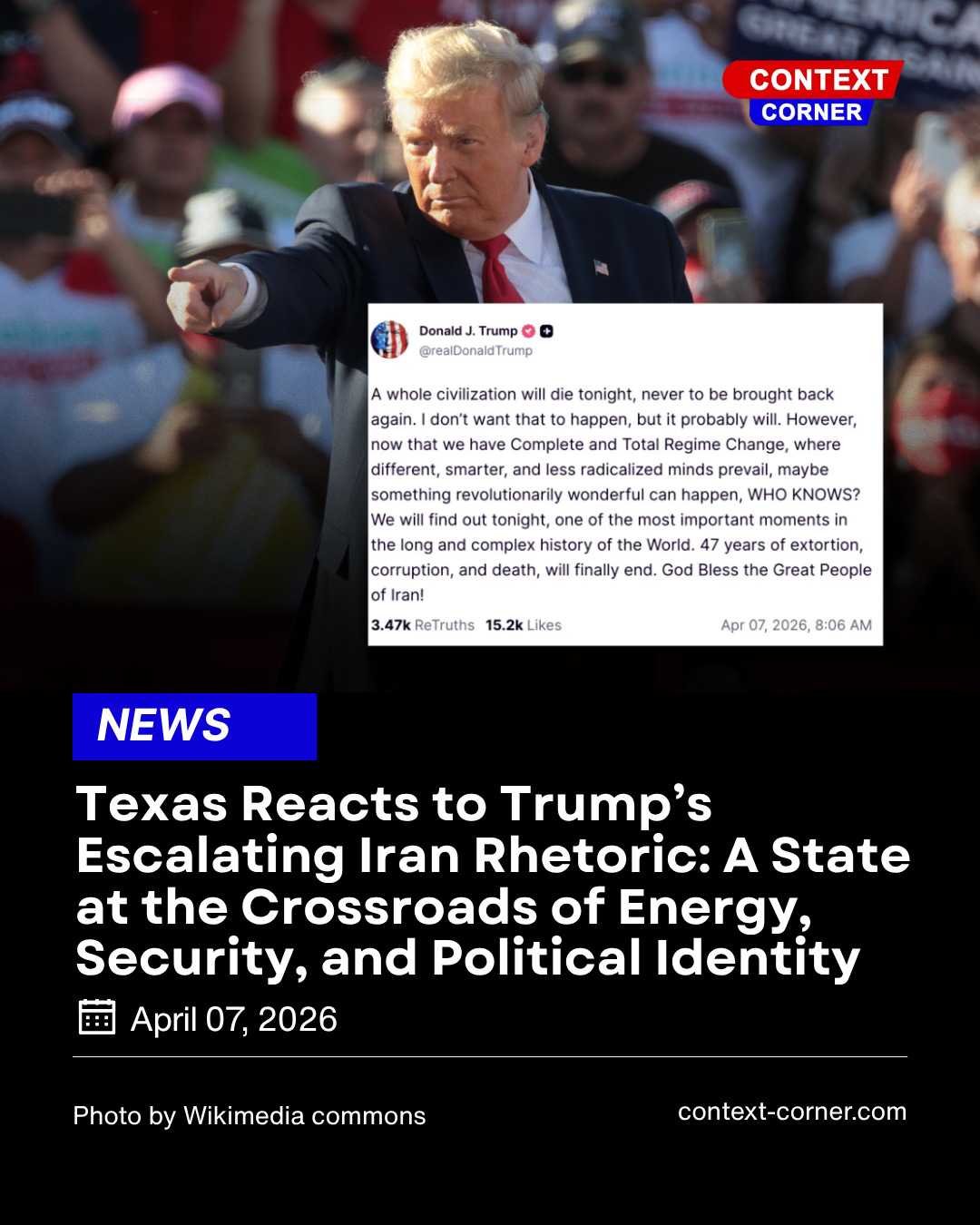
President Donald Trump’s recent comments about Iran — including threats of major retaliation if Tehran does not comply with U.S. demands — have triggered a wave of political responses across the country. Texas, with its vast military presence, global energy ties, and deeply polarized political environment, has become a key stage for interpreting the domestic fallout.
The president launched another shocking rant on Truth Social as his deadline for Iran to re-open the Strait of Hormuz looms. "A whole civilization will die tonight, never to be brought back again," he wrote. "I don't want that to happen, but it probably will."
This report examines how Texas leaders, institutions, and communities are responding, drawing on publicly reported statements and established political patterns in the state.
Texas as a Strategic and Symbolic Stage
Texas is uniquely positioned in moments of global tension:
It hosts major U.S. military installations, including Fort Cavazos and Joint Base San Antonio.
It is home to the headquarters of global energy companies whose operations depend on stability in the Strait of Hormuz.
Its political leadership often frames Texas as a frontline defender of national security.
Because of this, foreign‑policy rhetoric from Washington reverberates quickly through Texas’s political and civic life.
What Texas Officials Are Saying
Republican Leaders: Strong Support for Trump’s Posture
Rep. Dan Crenshaw (R–Houston)
Crenshaw defended Trump’s approach as necessary and stabilizing.
“You think this means WW3? You’re wrong… You think it means long‑term stability in the Middle East and a safer future for Americans? You’re right.”
Gov. Greg Abbott (R–Texas)
Abbott emphasized state readiness and alignment with federal leadership.
“Texas is elevating the readiness of our Department of Public Safety troopers and Texas National Guard… Texas stands with America’s Commander‑in‑Chief.”
Lt. Gov. Dan Patrick (R–Texas)
Patrick praised Trump’s actions in sweeping terms.
“President Trump just saved America and the world from fanatical terrorists in Iran… I have never been more proud of my President.”
Democratic Leaders: Warnings About Escalation and Legality
Rep. Jasmine Crockett (D–Dallas)
Crockett criticized the lack of congressional authorization.
“Congress must authorize military force before any president — including Trump — launches a strike.”
Rep. Greg Casar (D–Austin)
Casar warned against entering another prolonged conflict.
“It’s illegal for the president to drag America into another endless foreign war… Congress should immediately pass a War Powers Resolution.”
Rep. Lloyd Doggett (D–Austin)
Doggett expressed concern about escalation and oversight.
Doggett stressed that the strikes risked further escalation and emphasized the need for congressional oversight.
Local Government and Civic Leadership
Texas’s major cities — Houston, Dallas, Austin, San Antonio — have diverse communities, including Muslim, immigrant, and LGBT+ populations. Local leaders and civic groups have responded by:
Calling for calm and community safety
Warning against misinformation
Highlighting the potential for increased harassment or fear during geopolitical crises
Monitoring economic impacts on energy‑dependent regions
These responses reflect the lived realities of communities that often feel the ripple effects of global conflict most acutely.
Impact on Texas’s Energy Sector
Texas’s energy economy is deeply intertwined with global oil markets. Analysts in Houston have noted:
Potential volatility in oil prices
Risks to supply chains if the Strait of Hormuz remains unstable
Concerns among Texas‑based energy companies about long‑term geopolitical uncertainty
The economic dimension makes Texas particularly sensitive to U.S.–Iran tensions.