


“Sharia law” has emerged as a dominant theme in Texas Republican primary campaigns ahead of the March 2026 elections, with the state GOP placing a ballot proposition asking voters whether “Texas should prohibit Sharia Law” on the primary ballot despite legal scholars and Muslim community leaders warning the rhetoric exploits fundamental misunderstandings of Islamic principles. The non-binding Proposition 10, approved by the State Republican Executive Committee in September 2025 by a 59-3 vote, represents the culmination of a year-long escalation in anti-Muslim political messaging that has roiled Texas politics and drawn accusations of religious discrimination.
The proposition will appear before Republican primary voters on March 3, 2026, with early voting beginning February 17, as part of a 10-question survey designed to guide the party’s legislative priorities for 2027. Party officials describe the measure as gauging voter support for issues important to conservatives, though the Houston Chronicle reported that experts characterize the Sharia rhetoric as “playing on a deep misunderstanding of the Muslim faith”.
Governor Abbott Signs “Sharia Ban” Legislation
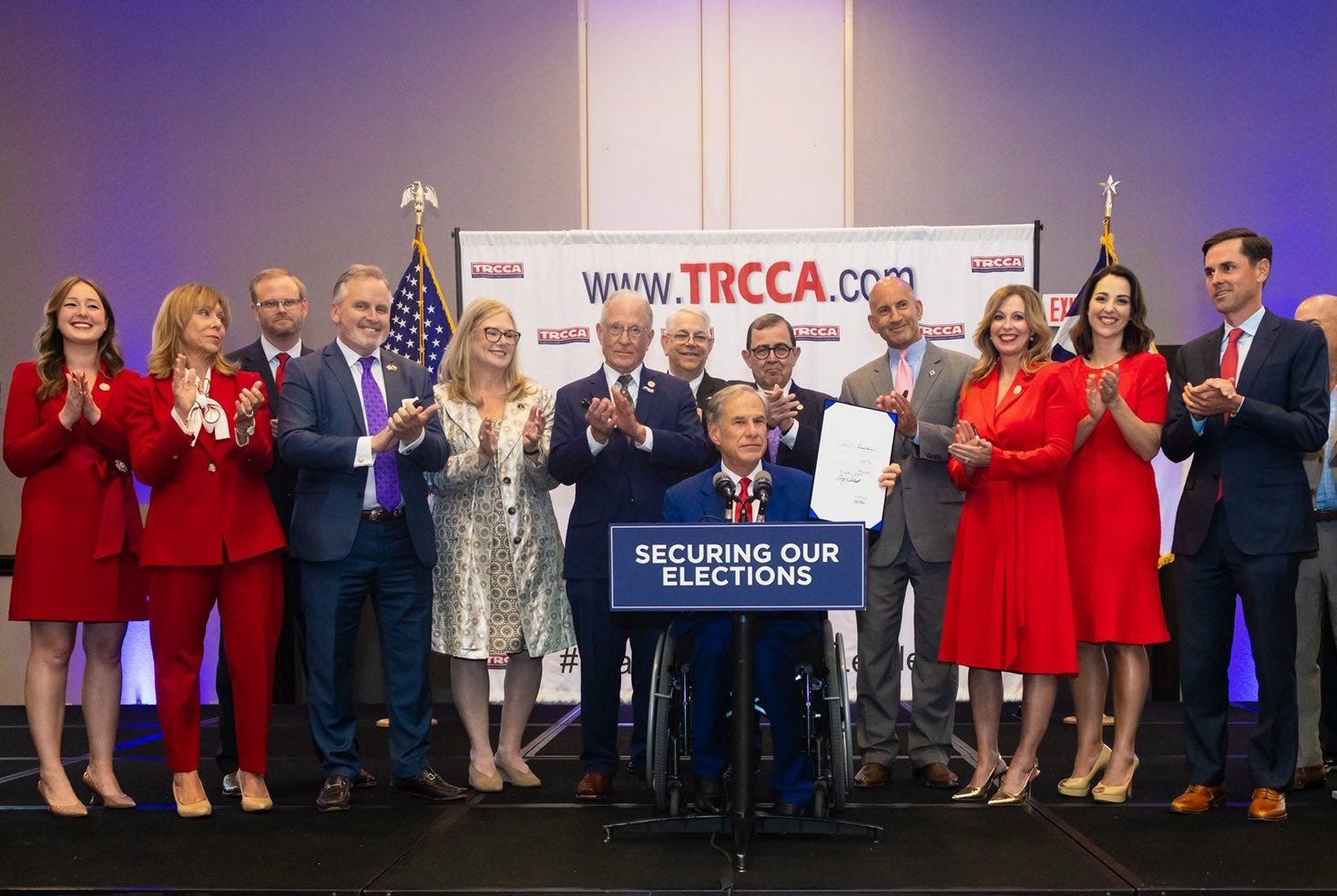
The primary ballot measure follows Governor Greg Abbott’s ceremonial signing in September 2025 of House Bill 4211, which he described as banning “Sharia law communities” in response to EPIC City, a proposed Muslim-majority residential development near Dallas. Speaking with FOX 26’s Greg Groogan, Abbott declared that “imposing Sharia law clearly violates the Texas Constitution that provides freedom of religion”.
“There’s no neighborhood in the state of Texas that can be limited only to one particular religion. It has to be open to everybody.”
— Governor Greg Abbott, FOX 26 Houston interview
Abbott argued that EPIC City “tried to create a community limited only to Sharia law and to Islamics and those who believe in Islam and Muslims from being able to live in the community,” calling it “religious segregation” that violates both the Texas Constitution and the Texas Fair Housing Act. The U.S. Justice Department found that EPIC City developers committed to complying with federal fair-housing laws, though Abbott and Attorney General Ken Paxton maintain that state investigations are ongoing. The project has since been renamed The Meadow and has not commenced construction.
Muslim Republicans Push Back Against Party Rhetoric
Some Muslim Republicans have criticized their party’s focus on Islamic law as politically motivated and factually baseless. Mo Nehad, a police officer who ran as a Republican in Fort Bend County last year, labeled Abbott’s actions “absurd,” telling The Washington Post: “There is no foundation for it”. Nehad dismissed concerns about Muslims imposing Sharia law in Texas as “biased and unproven”.
Mark Jones, a political science fellow at Rice University, explained to The Washington Post that “there is a faction within the Texas Republican Party that perceives Islam as an existential threat to Christianity”. Jones noted these Republicans “view the growth of Islam in Europe as a warning of what could transpire in the United States if they are not vigilant”.
In a November radio interview, Abbott connected his anti-Sharia stance to concerns about Texas’s growing Muslim population and the election of Muslim officials like New York Mayor Zohran Mamdani. “The concern is significant, especially when you see someone like Mamdani being elected and the catastrophic issues that may arise from that,” Abbott stated, adding: “We have freedom of religion; however, your religion must not threaten our freedom”.
Congressional and State-Level Escalation
The state-level rhetoric coincides with the formation of a “Sharia Free America Caucus” announced in December 2025 by Texas Republican Representatives Keith Self and Chip Roy, alongside Alabama Senator Tommy Tuberville. According to Fox News Digital, the caucus aims to advance legislation prohibiting entry and deporting foreign nationals deemed to adhere to Sharia law, and to designate the Muslim Brotherhood as a terrorist organization.
“America is facing a threat that directly attacks our Constitution and our Western values: the spread of Sharia law,” Roy stated, claiming that “instances of Sharia adherents masquerading as ‘refugees’ — and in many cases, sleeper cells connected to terrorist organizations — are threatening the American way of life”. Self told Fox News the caucus will “start educating the American people to the dangers of Sharia in the United States,” calling Islamic law “fundamentally incompatible with the U.S. Constitution”.
Local Governments Follow Statewide Pattern
The statewide focus on Sharia law has filtered down to municipal governments. The Keller City Council approved a resolution on January 6, 2026, affirming the supremacy of the U.S. and Texas constitutions in municipal matters after Muslim residents challenged an earlier draft that explicitly targeted Sharia law. Mujeeb Kazi, president of the North Texas Islamic Council and longtime Keller resident, told the council that Muslims in Texas are “saying here we go again with the boogie man and Sharia law, which doesn’t even exist,” arguing that “politicians are using Sharia law as a political football to gin up hatred of Muslims to galvanize their bases for the coming election”.
Keller Mayor Bill Mizani, who is running in the March 2026 Republican primary for Texas House District 98, defended his original “No Sharia Law” proclamation as an affirmation of constitutional supremacy. He told reporters the city “will not recognize any development, foreign entity, or organization that attempts to establish its own standards and rules,” according to Yahoo News.
CAIR and Muslim Brotherhood Designations
In November 2025, Abbott classified the Council on American-Islamic Relations and the Muslim Brotherhood as “foreign terrorist organizations,” claiming they seek to “undermine our laws through violence, intimidation, and harassment”. The designation would prevent CAIR from purchasing land in Texas and enable the state attorney general to pursue legal action to dissolve the organization, Abbott stated.
CAIR responded by calling Abbott’s social media posts “fearmongering about Islam” and urged the governor to visit Texas mosques to learn about Islamic principles. “Governor Abbott should visit one of the many mosques across Texas to learn about what sharia really is,” a CAIR spokesperson stated, adding: “In the meantime, he should know that the Texas Muslim community fears God, not dishonest fearmongering from politicians who understand Islam about as well as they understand the First Amendment”.
Historical Context and Political Strategy
The current campaign builds on years of anti-Muslim rhetoric in Texas Republican politics. In 2017, State Representative Kyle Biederman held a “Homeland Security – Defending Against Radical Islam forum” to gather information for legislation calling for measures to protect against Islamic terrorism in Texas, according to TPR. A 2016 University of Texas poll found that 76 percent of Texas Republicans supported a Muslim ban, compared to 25 percent of Democrats and 53 percent overall, The Texas Tribune reported.
The Washington Post reported that Abbott’s actions represent part of a broader GOP strategy in Texas and Florida targeting Muslim advocacy organizations, with both Abbott and Florida Governor Ron DeSantis designating CAIR a terrorist organization through executive actions typically reserved for the State Department. The Hill noted that these politicians are “attempting to limit financial support to Muslim organizations, especially following the recent Israel-Gaza conflict, by associating them with terrorist factions”.
As the March primary approaches, the Sharia ballot proposition ensures the issue will remain central to Republican campaigns, with potential ramifications for Muslim civic participation and religious freedom debates extending well beyond Texas. Political analysts note that while some Muslim voters have historically aligned with Republican economic and religious liberty principles, the party’s embrace of anti-Sharia rhetoric may be reshaping those traditional alliances in unpredictable ways.