


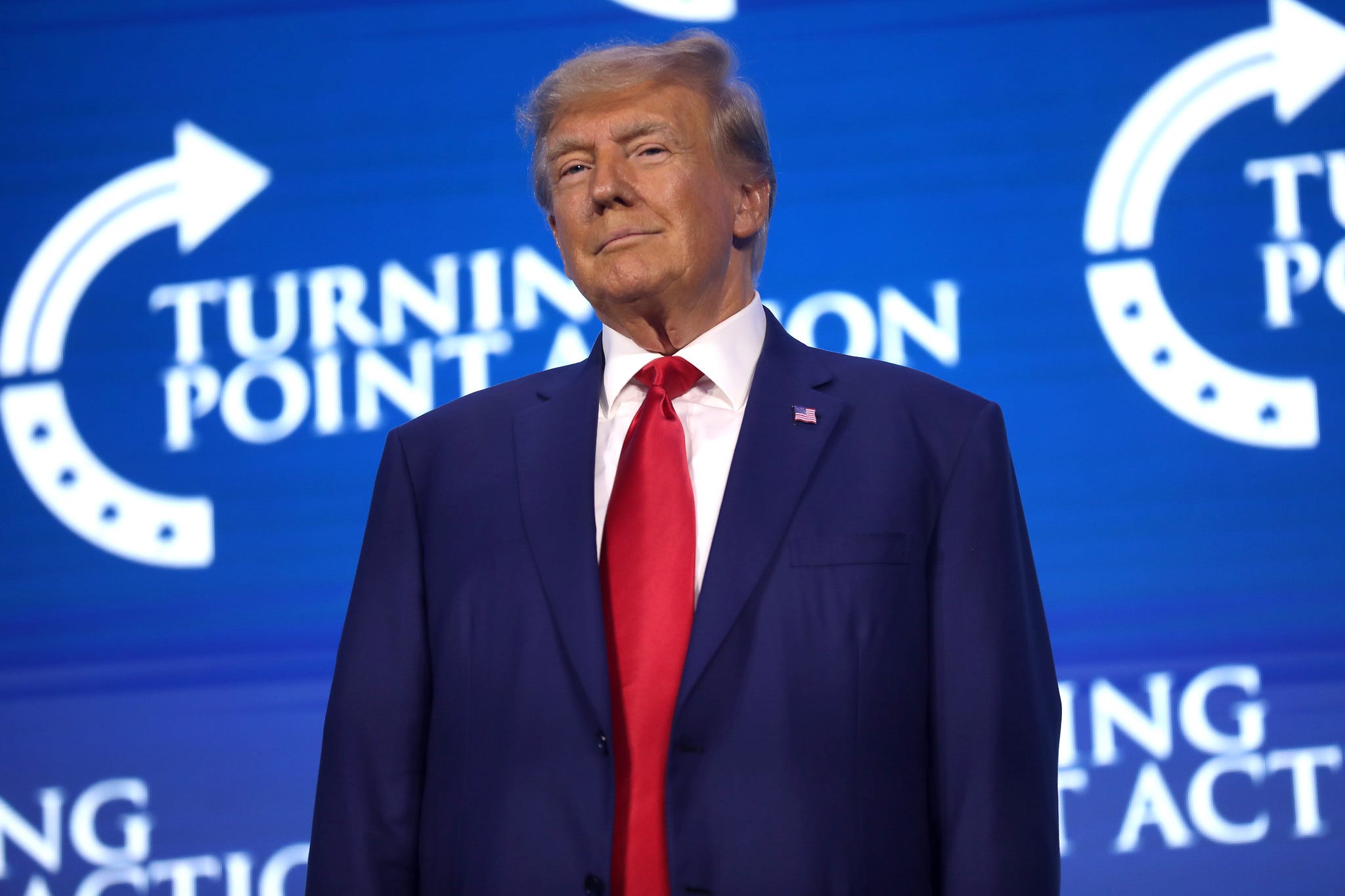
President Donald Trump has developed a peculiar habit of invoking the number 92 percent across a wide range of unrelated claims, according to an analysis published in The Atlantic on December 20, 2025. The pattern has become so pronounced that researchers and fact-checkers now view it as what poker players might recognize as a “tell”—a signal that indicates when the president is likely fabricating statistics.
Marie-Rose Sheiner, writing in The Atlantic, documented how Trump “likes to use a big number to anchor his point, especially when he wanders off on a tangent.” The analysis revealed that the president has repeatedly cited figures between 91 and 93 percent when making claims that later proved demonstrably false or grossly exaggerated.
“Often it seems that a specific figure is on the tip of his tongue,” Sheiner wrote, noting the curious pattern that emerged while tracking down the basis for serious claims the president has made regarding U.S. military operations near Venezuela.
A Recurring Number Across Multiple False Claims
The most recent example occurred during this year’s White House turkey pardon ceremony. Trump praised Wayne County, North Carolina, for providing two “record-setting” birds, then pivoted to his electoral performance in that area. “I won Wayne County by 92 percent,” he claimed, according to The Atlantic. In reality, he won by just 16 percentage points.
“His fixation on the number between 91 and 93 has been a feature for a while.”
— Marie-Rose Sheinerman, The Atlantic
At a McDonald’s corporate gathering, Trump asserted that the United States controls 92 percent of the Gulf of Mexico’s shoreline—which he now refers to as “the Gulf of America”—when the actual figure is closer to 46 percent, Political Wire reported on December 19. On Veterans Day, he stated he had won the veterans’ vote by “about 92 percent or something,” The Atlantic documented. In July, he claimed to have won farmers by 92 percent.” More accurate data from exit polls and election results indicate he secured 65 percent of veterans and 78 percent of voters in agricultural areas.
In April 2025, Trump claimed that egg prices had fallen by 92 percent, according to The Atlantic. The Bureau of Labor Statistics reported the actual decrease was 12.7 percent. At a rally shortly before last November’s election, while criticizing journalists and the media, he allowed that “not all of them” are “sick people,” just “about 92 percent,” The Atlantic reported. “That one, admittedly, is difficult to fact-check,” Sheinerman noted.
Venezuela Claims and Life-Saving Calculations
The president’s most serious invocation of the 92 percent figure relates to military operations in the Caribbean. On December 8, 2025, Trump told Politico that drug trafficking via sea was down “by 92 percent,” according to The Atlantic. Later that same day, he adjusted the figure to “92 or 94 percent.” Three days later, he reiterated in the Oval Office that “drug traffic by sea is down 92 percent,” and the following day claimed, “We knocked out 96 percent of the drugs coming in by water.”
Trump frequently connects these claims with another assertion: “Every one of those boats you see go down just saved 25,000 American lives,” according to The Atlantic. He has referenced this figure of 25,000 lives saved per boat strike multiple times in December alone. If accurate, and considering 28 boats have been destroyed, that would imply 700,000 lives saved—a number far exceeding total U.S. drug deaths in any year.
“That makes no sense,” Adam Isacson, a drug trafficking expert at the Washington Office on Latin America (WOLA), told The Atlantic.
A Broader Pattern of Statistical Fabrication
Trump’s affinity for inventing statistics extends beyond the 92 percent figure. In 2019, Bloomberg noted that the number 10,000 frequently appeared whenever Trump made grand claims, The Atlantic reported. This included his assertion about known or suspected gang members removed by Immigration and Customs Enforcement (ICE) in 2018. Trump cited 10,000, though the agency reported the actual figure as 5,872.
At three rallies leading up to Election Day 2024, Trump boasted about his campaign against the press. “The fake news back there, they were at 92 percent approval when we started this journey in 2015,” he claimed, according to The Atlantic. “And now they’re less than Congress,” he added, expressing pride in that supposed achievement. In truth, when Trump began his political journey, Americans’ trust in the media was not 92 percent, as Trump claimed, but at a then-record low of 40 percent, according to Gallup polling data. Since then, it has fallen to a historic low of 28 percent, while Congress’s approval rating currently stands at 15 percent.
A Legacy of Documented Falsehoods
The pattern fits within Trump’s broader relationship with factual accuracy. The Washington Post Fact Checker documented 30,573 false or misleading claims during his first presidential term, averaging 21 erroneous claims per day, according to Wikipedia’s compilation of Trump’s false statements. CNN reported on April 29, 2025, that Trump “filled his first 100 days back in office with the same relentless dishonesty that was a hallmark of his first presidency.”
Academic research published in Public Opinion Quarterly in 2023 examined whether Trump’s repeated falsehoods influenced public perception. Researchers systematically selected 150 claims spanning five topics, with varying numbers of repetitions, and conducted a national survey. The study found “significant evidence” that repetition of false claims by Trump correlated with misperceptions among the American public, particularly Republicans and those consuming information primarily from right-leaning news outlets.
“What is especially striking is how the tsunami of untruths kept rising the longer he served as president and became increasingly unmoored from the truth,” the Washington Post Fact Checker team wrote, according to a 2023 congressional document. Trump averaged about six claims per day in his first year as president, 16 claims per day in his second year, 22 claims per day in his third year, and 39 claims per day in his final year.
White House Defends Statistical Prowess
White House Chief of Staff Susie Wiles offered an unusual defense of the president’s numerical assertions in an interview with Vanity Fair, describing Trump as a “statistical savant,” according to The Atlantic. However, fact-checkers and mathematical experts remain skeptical.
“Perhaps Trump has arrived at these figures through some advanced mathematical reasoning beyond my understanding,” Sheinerman wrote in The Atlantic, her tone suggesting skepticism about that possibility.
Public polling indicates widespread doubt about Trump’s veracity. A September 2024 Associated Press/NORC at the University of Chicago survey found that a majority (57 percent) of Americans believed claims from Trump and his campaign are “rarely” or “never” based on facts, according to Wikipedia’s documentation. A June 2019 Gallup poll found that just 34 percent of American adults thought Trump “is honest and trustworthy.”
An Uncertain Impact on Policy
The president’s pattern of statistical fabrication raises questions about the basis for policy decisions, particularly regarding military operations in the Caribbean where 104 people have been killed in 28 U.S. airstrikes since September 2025, according to official statements documented by Wikipedia. Trump has used the unverified 92 percent reduction in maritime drug trafficking as partial justification for these operations.
The repetition of false statistics also complicates efforts by journalists, fact-checkers, and educators to maintain an informed electorate. Research from Full Fact, a British fact-checking organization, noted in its 2025 report that misinformation has become increasingly politicized, with the National Science Foundation abruptly terminating dozens of grants worth millions of dollars to researchers studying misinformation in April 2025.
As Trump’s second term continues, the “92 percent tell” serves as a reminder for media consumers to verify bold numerical claims, particularly when they anchor broader policy arguments. Whether the president will acknowledge the pattern or adjust his rhetorical habits remains to be seen. What is clear is that when Trump cites a figure hovering around 92 percent, there is, statistically speaking, a strong chance he is making it up.